Sophie's clinical protocol for Pilates vs Stretching for Lower Back Pain — evidence-based, NICE-aligned   See the Lower Back Pain Pilates program →

All comparisons › Lower Back Pain

Pilates vs Stretching · chronic · 8-week protocol

Pilates vs Stretching for Lower Back Pain

Generic stretching loosens what should be stable. The NICE NG59 guideline and the 2015 Cochrane review both name structured Pilates as a first-line intervention for non-specific low back pain — stretching alone is not on that list.

Included in Sophie's protocol: Supine Stable Pelvic BridgeQuadruped TA Engagement for StillnessFoot Roll ArticulationCadillac Stabilizing Pull
2,347+ Protocols downloaded
96% Satisfaction
4.9 Across 200+ reviews
NICE Guideline-aligned
7-day Money-back guarantee
I'd been told to stretch my hamstrings and hip flexors for years. It never lasted. Once I learned to actually stabilise the lumbar spine, the recurring pain finally stopped.
Sarah J. Leeds, UK Pain-free 4 months and counting · After 8 weeks
01

Supine Stable Pelvic Bridge
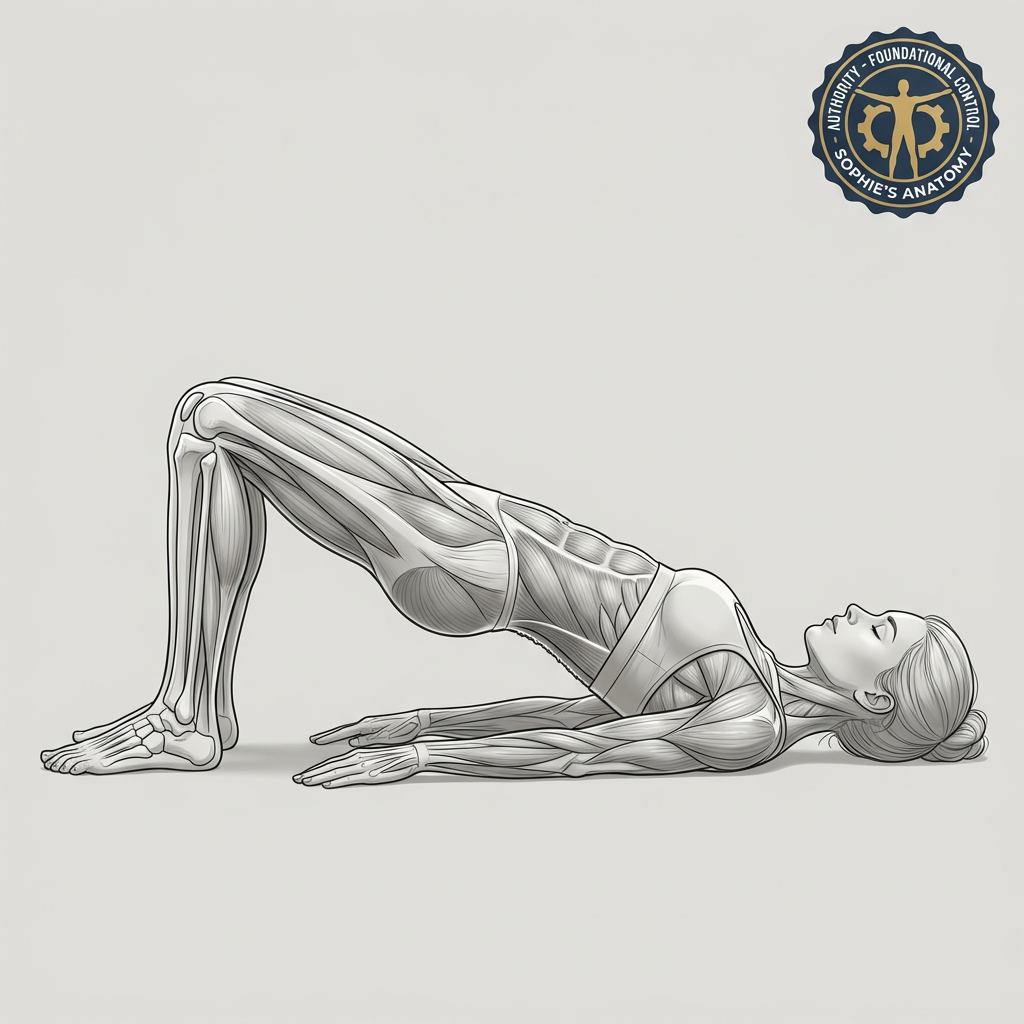
Functional close-up: Supine Stable Pelvic Bridge
Sophie's Deep Stabilisation Reset — Supine Stable Pelvic Bridge
Standard Stretching Generic passive stretching bypasses deep stabilisation entirely — temporary relief, no lasting change.
Sophie's Deep Stabilisation Reset Supine Stable Pelvic Bridge — precise, controlled activation that builds the functional stability your body needs.
02

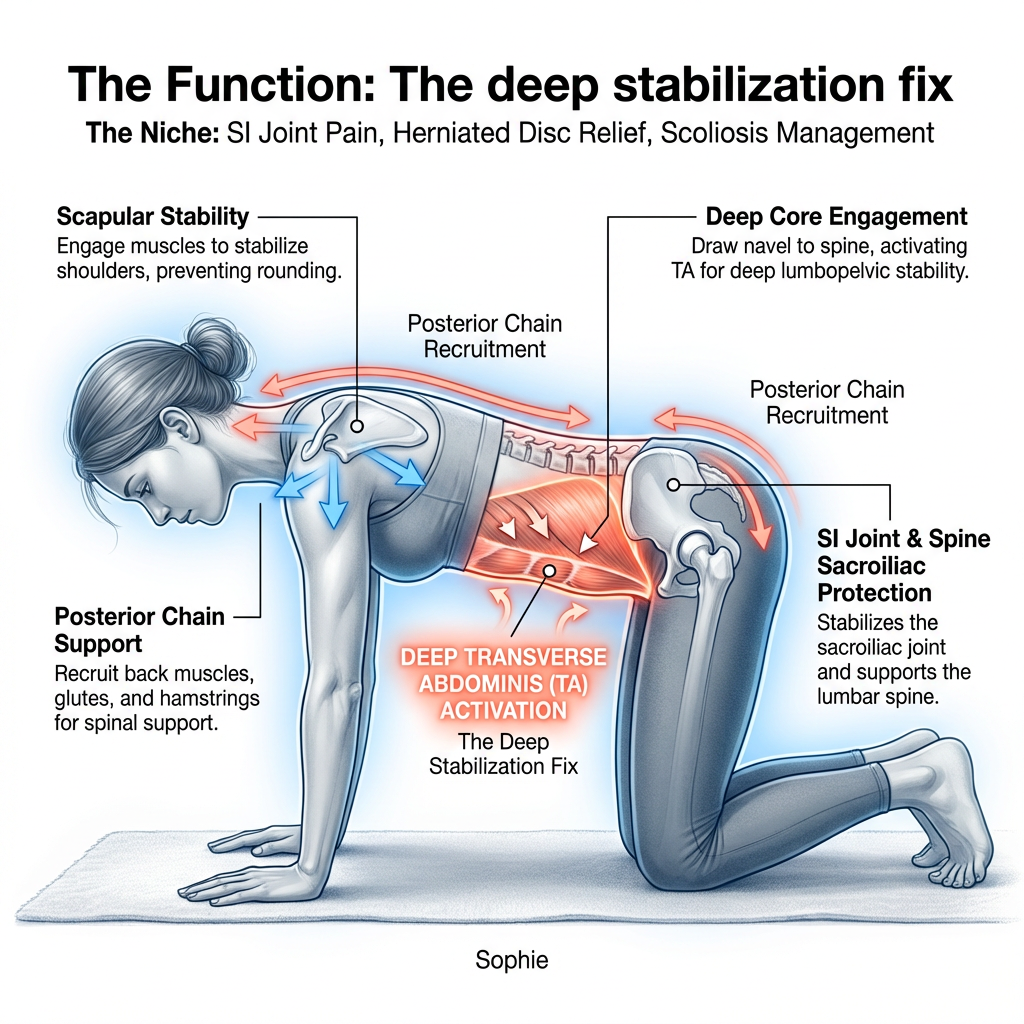
Quadruped TA Engagement for Stillness

Functional close-up: Quadruped TA Engagement for Stillness
Sophie's Deep Stabilisation Reset — Quadruped TA Engagement for Stillness
Standard Stretching Generic passive stretching bypasses deep stabilisation entirely — temporary relief, no lasting change.
Sophie's Deep Stabilisation Reset Quadruped TA Engagement for Stillness — precise, controlled activation that builds the functional stability your body needs.
03

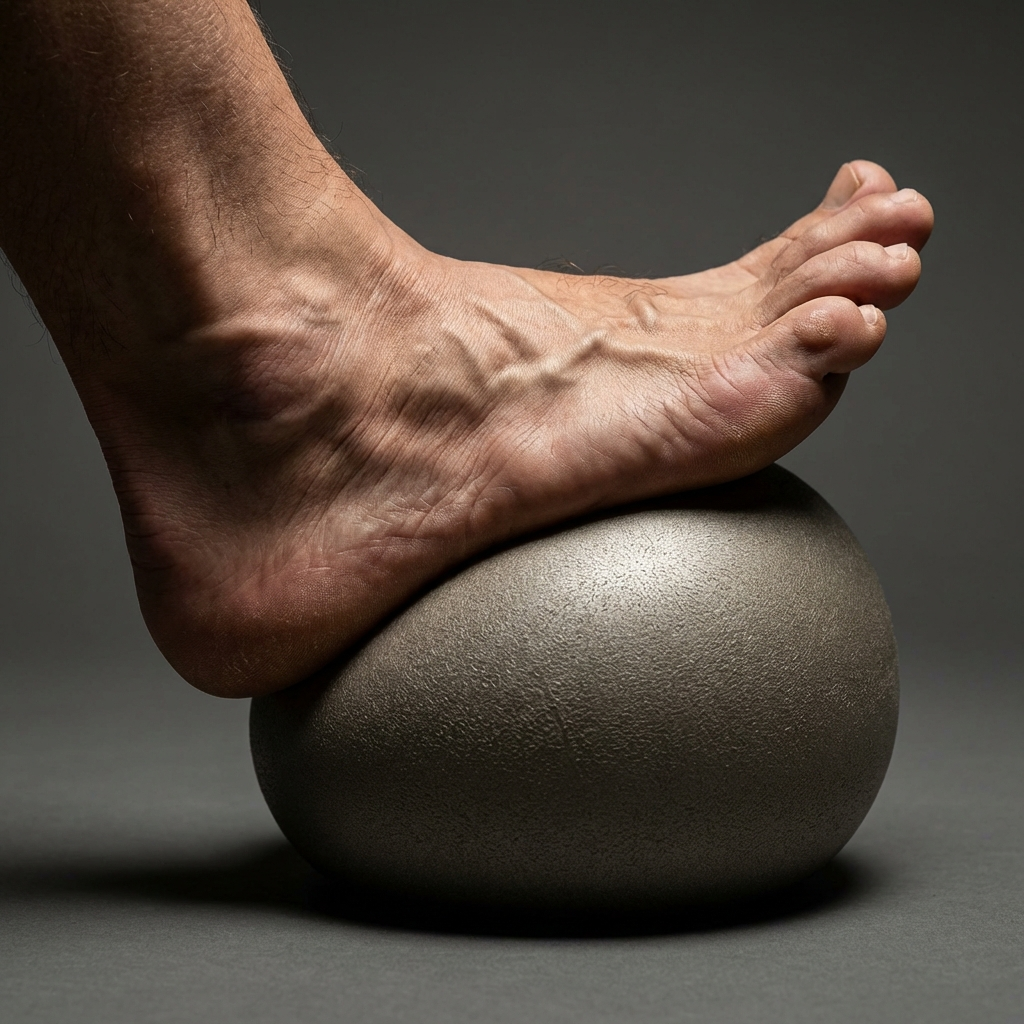
Foot Roll Articulation

Functional close-up: Foot Roll Articulation
Sophie's Deep Stabilisation Reset — Foot Roll Articulation
Standard Stretching Generic passive stretching bypasses deep stabilisation entirely — temporary relief, no lasting change.
Sophie's Deep Stabilisation Reset Foot Roll Articulation — precise, controlled activation that builds the functional stability your body needs.
04

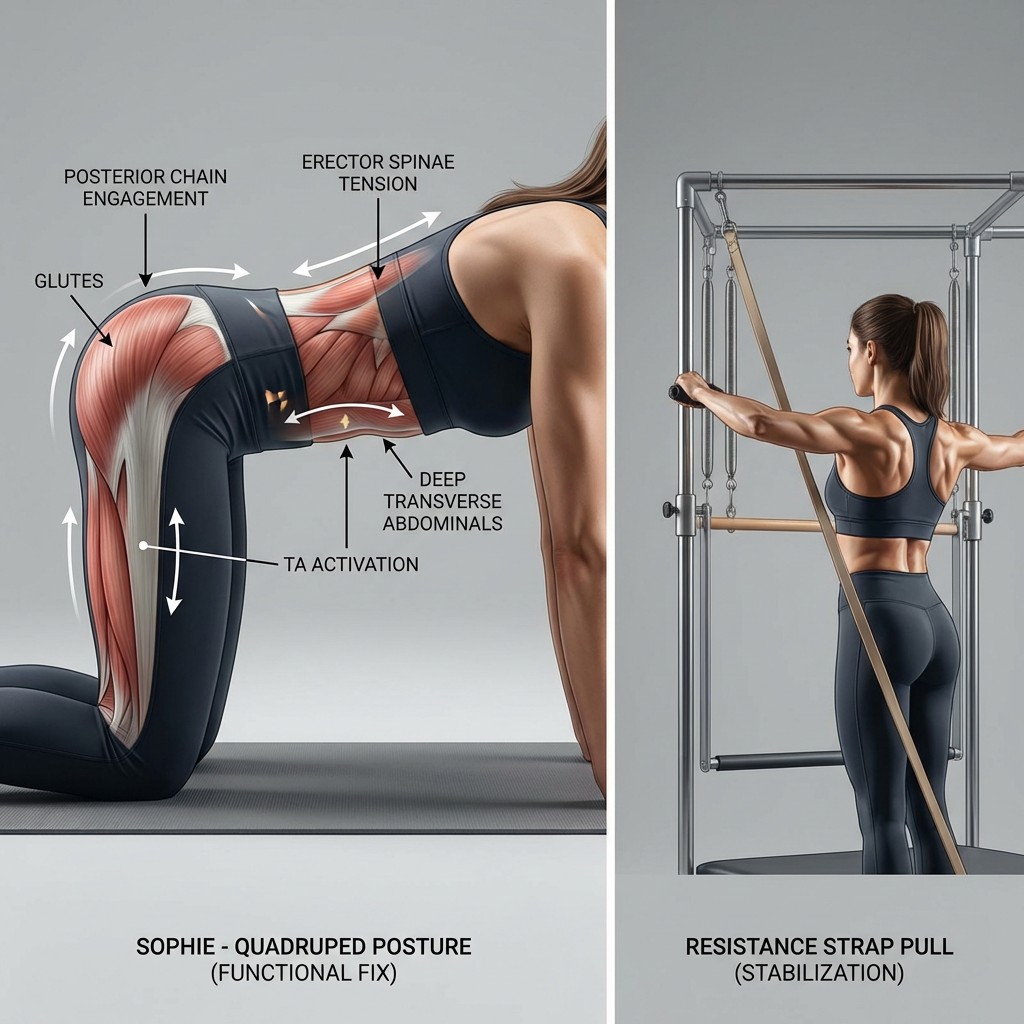
Cadillac Stabilizing Pull

Functional close-up: Cadillac Stabilizing Pull
Sophie's Deep Stabilisation Reset — Cadillac Stabilizing Pull
Standard Stretching Generic passive stretching bypasses deep stabilisation entirely — temporary relief, no lasting change.
Sophie's Deep Stabilisation Reset Cadillac Stabilizing Pull — precise, controlled activation that builds the functional stability your body needs.
🧬

Clinical Evidence: Pilates reduces lower back pain by up to 72% (Asik et al, 2025 RCT). NICE recommends Pilates as a first-line treatment for chronic lower back pain before medication.

If lower back pain overlaps with other back issues

Many people with lower back pain have related compensation patterns elsewhere in the spine. These comparisons walk through how Sophie's clinical Pilates protocols differ from generic stretching for each condition.

Browse the full library of evidence-based Pilates protocols for 35 conditions across back pain, sport-specific training, and post-surgical recovery.

Lower back pain is the single most common musculoskeletal complaint in adults — and the most consistently mishandled. The instinct is to stretch what feels tight. But in most chronic lower back pain, the tight muscles aren't the problem; they're the symptom. The actual driver is almost always a weakness or motor-control gap in the deep core, combined with a loss of hip mobility above and below the lumbar spine. Until those root issues are addressed, stretching offers only temporary relief — which is why most people end up cycling through the same flare-ups for years.

Why stretching alone rarely fixes lower back pain

The tight muscles you feel in chronic lower back pain — typically the lumbar erectors, the quadratus lumborum, the hip flexors — are doing emergency stabilisation. Your nervous system has decided the spine isn't safe without them, so it holds them in low-grade contraction around the clock. When you stretch them, you temporarily reduce their tone. The spine immediately feels less stable. Within minutes to hours, the nervous system re-engages them, often more strongly than before. That is the rebound tightness so many lower-back-pain sufferers experience after a good stretch session.

The second failure mode is even more common: stretching loads the lumbar spine into flexion. For a person with discogenic pain or facet joint irritation — which together account for most chronic lower back pain — flexion is the exact position that aggravates the underlying tissue. Forward folds, knees-to-chest, child's pose: each feels like relief but quietly re-provokes the source of the pain. People report feeling great during the stretch and dramatically worse the next morning, never connecting the two.

Stretching also does nothing to address the upstream and downstream contributors. Tight hip flexors anteriorly tilt the pelvis, which loads the lumbar spine. Weak gluteals fail to stabilise the pelvis during walking and lifting, so the lower back compensates. Reduced thoracic mobility forces the lumbar segments to make up the rotation deficit. None of these resolve with stretching the lower back itself — and all of them must resolve for the pain to stop returning.

What clinical Pilates does instead

A clinical Pilates protocol for lower back pain restores function in the four places that actually matter: the deep core that should be stabilising the lumbar spine, the hip mobility that should be absorbing rotation and flexion demands, the thoracic mobility that should be sharing the movement load, and the gluteal strength that should be propelling and supporting the pelvis. Stretching the lower back itself is barely touched — because it isn't the problem.

The deep core work is the centrepiece. Transversus abdominis, the deepest layer of the abdominal wall, wraps around the spine like a corset. In chronic lower back pain, its automatic firing is delayed or absent. Pilates rebuilds this firing pattern systematically — first in supine (where the spine is supported), then in quadruped, then in standing, then in functional movement. Multifidus, the deep spinal stabiliser, is rebuilt in parallel. By week six, most clients can feel their core engaging automatically before they move — the foundation of a back that no longer flares.

Around that core work, the protocol restores hip extension (almost universally limited from sitting), thoracic rotation (the rotational reservoir the lumbar spine needs above it), and gluteal control. The result is a spine that no longer relies on protective tension — because the surrounding system is doing its job again.

The structure of a typical session

Sessions are 25–30 minutes, three to four times per week, with progressive intensity across eight weeks.

01
Pelvic alignment & breath (4 min)
Supine pelvic clock and 360-degree breathing. Resets the relationship between the pelvis, ribcage and diaphragm — the foundation everything else builds on.
02
Deep core activation (8 min)
Transversus abdominis and multifidus drills. Starts as static co-contraction; by week 6 progresses to dynamic load with leg or arm movement.
03
Hip mobility work (6 min)
Hip flexor release in lunge position, glute activation in bridge variations, internal/external rotation drills. These restore the mobility above and below the lumbar spine.
04
Functional integration (8 min)
Hip hinge patterning (the foundation of a safe lift), single-leg balance work, controlled rotation. This is the bridge between exercise and real-life movement.
05
Reset & breath (4 min)
Supported relaxation and a 90-second breathing drill that down-regulates protective tension and reinforces the new motor patterns.

Side-by-side: stretching vs Sophie's Pilates protocol

Standard stretching
Sophie's clinical Pilates
Targets root cause
Targets the symptom (tight back muscles).
Targets the cause (weak core, restricted hips, motor control gap).
Effect on disc / facet pain
Most stretches load the spine in flexion — can re-irritate.
Excludes provocative flexion in early weeks; builds tolerance progressively.
Long-term outcome
Pain returns once stretching stops.
Motor patterns persist — the back can support itself.
Time commitment
Indefinite daily stretching forever.
Concentrated 8-week build, then a brief maintenance routine.
What you can do afterwards
Same activities, but with constant low-grade fear of flare.
Lift, run, sit, garden — without thinking about your back.

Is this protocol right for you?

Good fit if
  • Adults with chronic or recurrent lower back pain longer than 6 weeks
  • People whose stretching has plateaued or provides only short-term relief
  • Desk workers with daily low-grade lower back discomfort
  • Anyone wanting to lift, garden, or play sport without fear of flares
  • Post-physio clients ready for a structured progressive programme
Hold off / see a clinician if
  • Acute lower back pain in the first 1–2 weeks of onset — let the inflammatory phase settle first
  • Red-flag symptoms (loss of bladder/bowel control, saddle numbness, progressive leg weakness, unexplained fever) — see a clinician immediately
  • Anyone not yet medically cleared after spinal surgery
Recommended protocol

Sophie's Complete Lower Back Pain Protocol

8-week progressive programme · 34 clinical exercises · Weekly schedules · Recovery tracker

What's inside

  • All 34 exercises photo-demonstrated, with detailed cues
  • Phased progression: decompression → stabilisation → integration
  • Weekly milestones and printable workout logs
  • Contraindication list specific to this condition
  • Built for home practice on a mat — no studio required
“I'd been told to stretch my hamstrings and hip flexors for years. It never lasted. Once I learned to actually stabilise the lumbar spine, the recur...” — Sarah J., Leeds, UK · Pain-free 4 months and counting (After 8 weeks)
$67 $37 Save $30
Get the full Lower Back Pain protocol →
2,347+ Downloads
96% Satisfaction
4.9 Across 200+ reviews

7-day money-back guarantee · Instant PDF download

Frequently asked questions

How is this different from generic core training?
Generic core training (crunches, planks, sit-ups) recruits the superficial abdominal muscles that already work fine. The deep stabilisers — transversus abdominis and multifidus — require very specific, low-load activation to retrain. The protocol teaches you these from scratch using progressions that physiotherapists use clinically. By the time you reach plank-style work in week 5, the deep stabilisers are doing their job and the superficial muscles can train without compensating.
What if my MRI shows a disc bulge?
Disc bulges are extremely common — large imaging studies show 30–40% of pain-free adults have visible disc bulges on MRI. The bulge itself often is not the pain source. What matters is whether the surrounding muscular and motor-control system can support the spine. The protocol is appropriate for stable disc bulges and builds the support system that takes load off the disc. If you have specific clinical concerns from your MRI, share the imaging report with your GP or physio before starting.
I've had lower back pain for years. Can eight weeks really change that?
For most people, yes — and this is a consistent finding in chronic lower back pain research. The reason is that chronic pain rarely reflects ongoing tissue damage after the first few months. It reflects motor-control gaps, fear-avoidance patterns, and deconditioned support muscles. Each of these is highly responsive to structured exercise. Most clients with multi-year histories report meaningful change by week 4 and substantial change by week 8.
Do I need to warm up before each session?
No. The session is the warm-up. The opening four minutes intentionally serve that role — the pelvic alignment work and breathing reset prepare the body for the deeper work that follows. If you're particularly stiff in the morning, the protocol provides a 3-minute pre-session mobiliser.
Will my pain get worse before it gets better?
A mild increase in muscle soreness — like any new exercise — is normal in the first two weeks, especially in the deep core. Sharp pain, nerve pain, or pain that worsens day-over-day is not normal and is a signal to step back. The protocol includes clear pain-monitoring rules so you know when to progress, when to repeat a week, and when to consult a clinician.
Can I keep going to the gym while I do this?
Yes, with adjustments. Heavy bilateral spinal loading (back squats, deadlifts, overhead press) is best paused for weeks 1–3 while the deep stabilisers come back online. Single-leg, single-arm and upper-body isolation work is fine throughout. The protocol explicitly addresses how to return to lifting safely in weeks 6–8.
Do I need a foam roller?
A foam roller helps with thoracic mobility work and can be used for gluteal release, but is not essential. A folded towel or pillow substitutes for most uses. A tennis ball is recommended for targeted glute and piriformis release.
Pilates vs Stretching for Lower Back Pain Protocol — $37 Get the Lower Back Pain program →