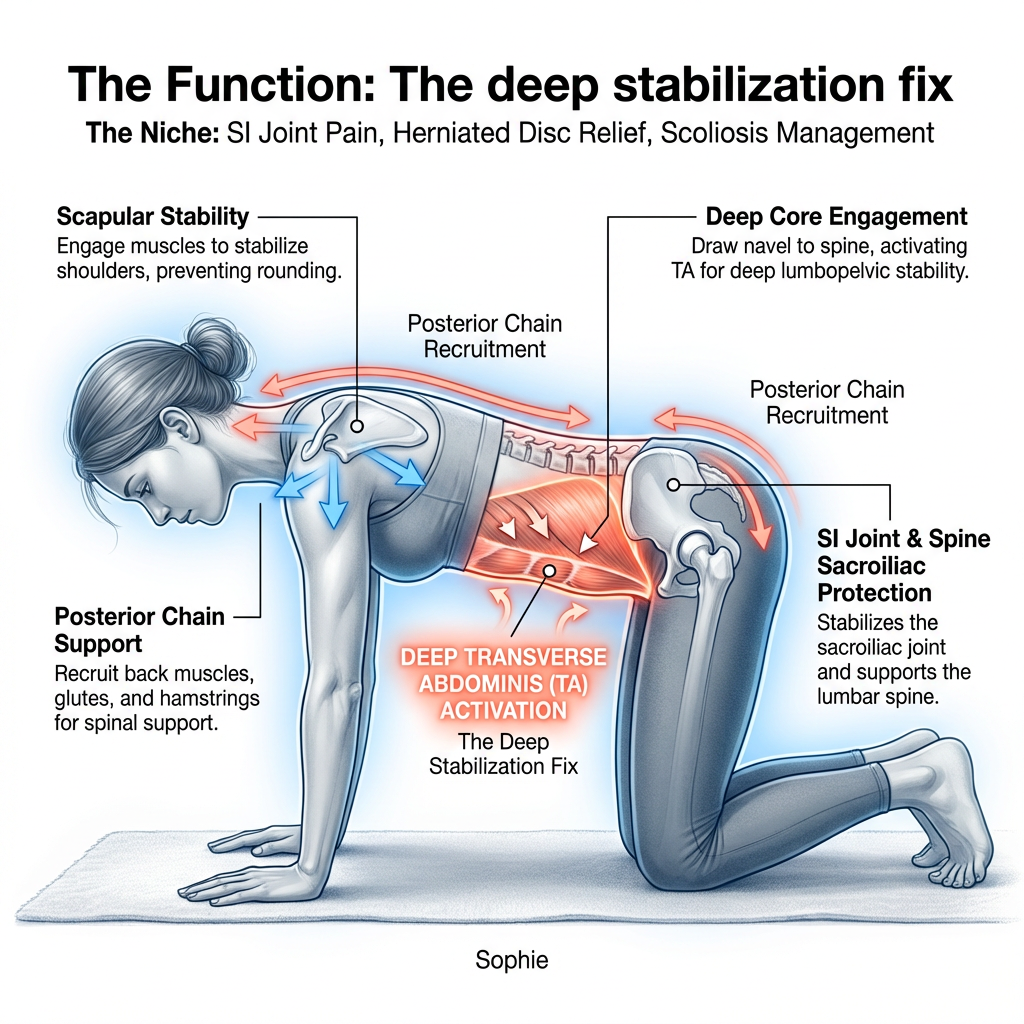
Neutral Lumbar Quadruped TA Engagement
Most generic stretches load the lumbar disc in flexion, which is exactly the position that can push disc material toward the nerve. Sophie's protocol holds the spine in protective neutral and builds the deep stabilisers that take pressure off the disc.
After my L5/S1 herniation my physio said no flexion. I had no idea what to actually do at home until this protocol. Twelve weeks in, I'm back to normal life.
Clinical Evidence: Pilates reduces lower back pain by up to 72% (Asik et al, 2025 RCT). NICE recommends Pilates as a first-line treatment for chronic lower back pain before medication.
Many people with herniated disc have related compensation patterns elsewhere in the spine. These comparisons walk through how Sophie's clinical Pilates protocols differ from generic stretching for each condition.
Browse the full library of evidence-based Pilates protocols for 35 conditions across back pain, sport-specific training, and post-surgical recovery.
A herniated lumbar disc is one of the most feared diagnoses in lower back pain, but it is also one of the most predictable to manage. The vast majority of herniated discs (some studies put it above 80%) resolve symptomatically with non-surgical care over 6–12 weeks. The crucial decision is not whether to exercise — it is which exercises to do, and which to avoid. Standard stretching gets this exactly wrong: most recommended stretches load the disc in the direction that worsens herniation. A clinical Pilates protocol does the opposite.
The intervertebral disc is a sealed unit of cartilage with a tough outer ring (the annulus fibrosus) and a gel-like centre (the nucleus pulposus). A herniation occurs when the nucleus pushes through a tear in the annulus, sometimes contacting nerve roots. The key biomechanical principle is direction: spinal flexion (forward bending) pushes the nucleus posteriorly toward the back of the disc, where most herniations occur. Spinal extension (backward bending) pushes it anteriorly, away from the herniation.
Every common stretch for back pain — knee-to-chest, seated forward fold, child's pose, supine spinal twist with the knees pulled across — loads the spine into flexion. For someone with a posterior disc herniation, these are precisely the movements that worsen the injury. They feel temporarily good because the lumbar muscles release, but the nuclear material is being pushed further into the damaged area of the annulus. Symptoms predictably worsen, often dramatically, the following day.
Stretching also fails to address the actual recovery requirement: rebuilding the muscular support system around the spine so the damaged disc can heal without ongoing mechanical aggravation. Static stretching teaches the body nothing about how to brace, stabilise, or move safely with a vulnerable disc.
A herniated-disc Pilates protocol is built around a single biomechanical principle: maintain neutral lumbar spine, avoid flexion, build the support system. Every movement in weeks 1–6 is selected because it loads the spine in neutral or gentle extension — never in flexion. The deep stabilising muscles (transversus abdominis, multifidus) are rebuilt systematically so the spine has muscular support rather than relying on the damaged disc to bear load. The hip mobility above and below the lumbar spine is restored so daily movement no longer demands flexion at the injured level.
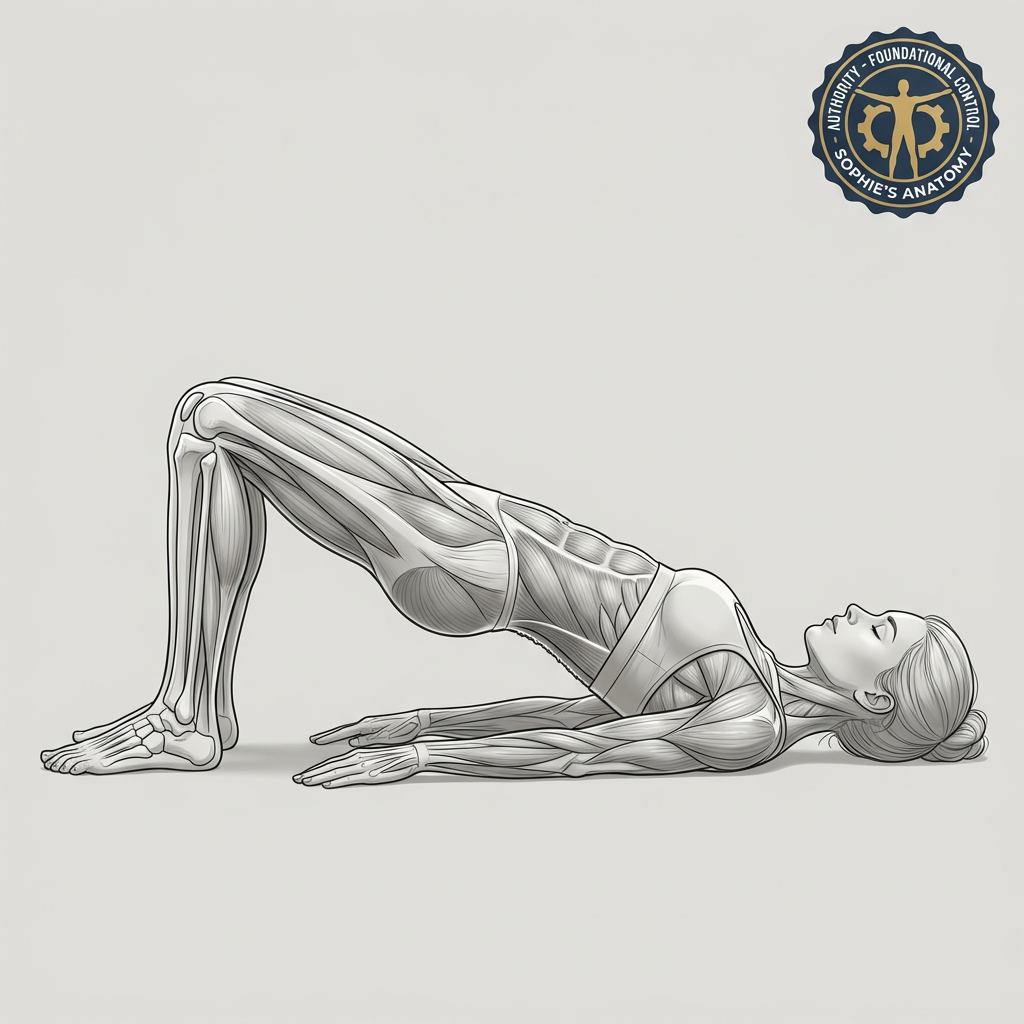
Phase progression matters more here than in any other condition. Weeks 1–3 are deliberately very gentle: supine and quadruped work, no rolling or curling, no flexion-based abdominal work. Weeks 3–6 introduce graded loading in neutral spine — bridges, bird dogs, side planks. Weeks 6–12 reintroduce controlled spinal movement, including gentle flexion, only once the support system is reliable enough to protect the disc.
The result, supported by both randomised controlled trials and clinical practice, is that most disc-herniation clients return to pain-free function in 8–12 weeks with the underlying disc healing in the background. Surgery rates in this population, when guided exercise is followed, are very low — typically under 10%.
Sessions are 20–25 minutes (deliberately shorter early on), three to four times per week. Quality of movement matters far more than duration.
12-week progressive programme · 48 clinical exercises · Weekly schedules · Recovery tracker
“After my L5/S1 herniation my physio said no flexion. I had no idea what to actually do at home until this protocol. Twelve weeks in, I'm back to no...” — Daniel K., Bristol, UK · Returned to running (After 12 weeks)
7-day money-back guarantee · Instant PDF download